Toyota Sports Complex Raking in the Revenue

imageRecently released revenue figures from City Hall show that the Toyota Sports Complex generated $373,681 in field rental fees during its first year of operation. That number is well above the maximum projected revenue of $296K city staff had forecasted back in February 2014. Those revenue figures are offset, somewhat, by yearly maintenance costs of $220K budgeted by the City.  Still, the better than forecasted revenues must be a welcome sight for a City suffering from significant revenue hits of as much as $700K a month due to the ExxonMobil explosion and resultant shutdown of the local refinery.

In addition to revenue, the field provides other more difficult to measure benefits to the City. During his campaign for mayor, for example, then Councilmember Furey expressed hope that the fields would help Torrance become the “Williamsport” of youth soccer. Though Torrance has yet to rise to that level, the complex does attract many people from outside the city for practices and tournaments. The hope is that those people frequent Torrance businesses thereby contributing to the health of the local economy and sales tax revenue.

The completion of the sports complex was championed by longtime AYSO volunteer and former mayor Frank Scotto and was perhaps one of the signature accomplishments of his tenure. It cost upwards of $3.5 Million to build and represents a significant investment from the community.
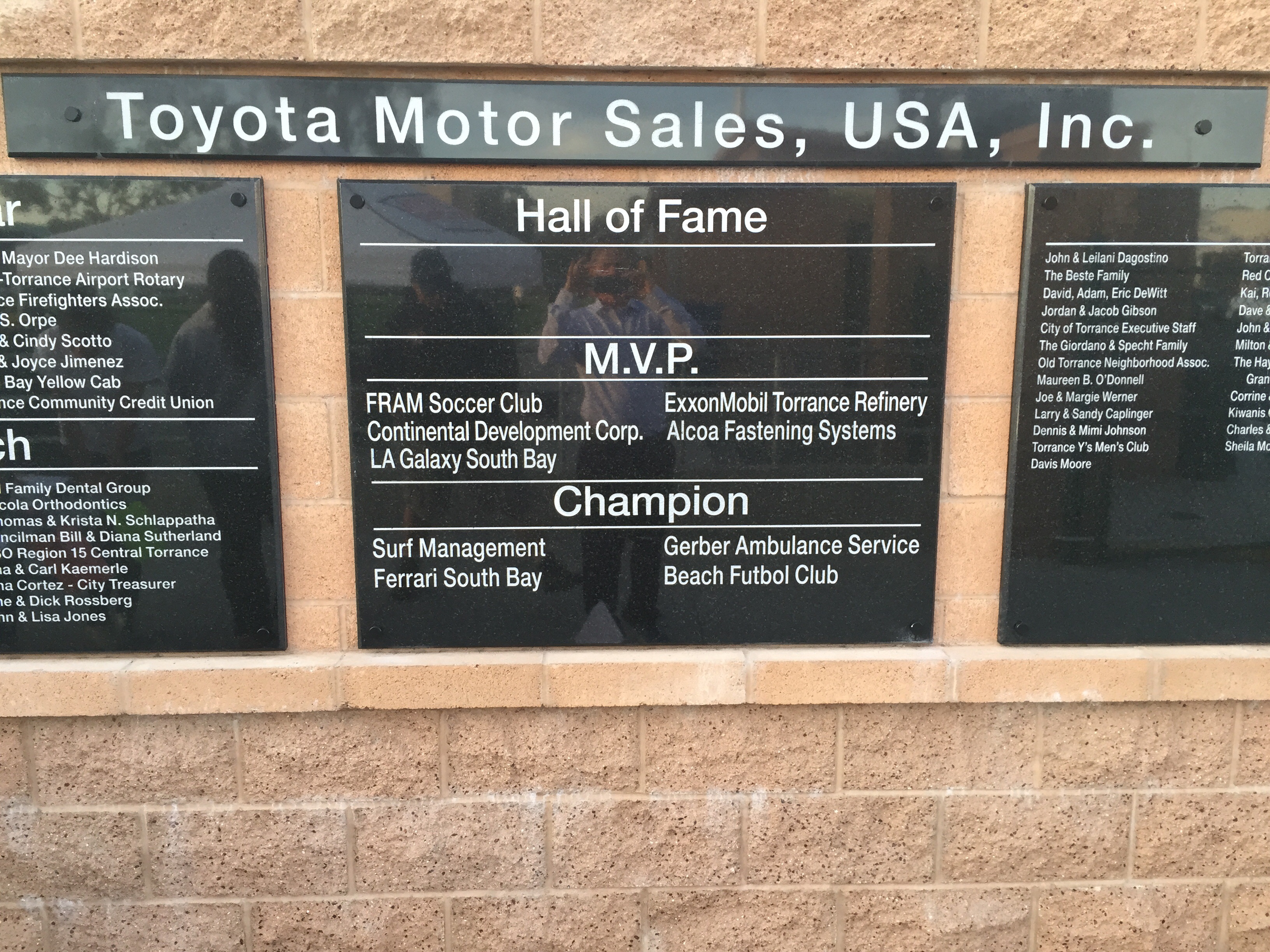
Toyota Sports Complex Donor Wall

Toyota Sports Complex Donor Wall

Some community partners helped reduce the taxpayer burden that came with the hefty price tag by contributing to the cause. Just prior to announcing they were leaving town, for example, Toyota gave $500K for the naming rights to the facility. Other entities also contributed just over $100K in total to have their names represented on the donor wall. Of those, direct beneficiaries LA Galaxy and FRAM Soccer pitched in $10K a piece while Beach Futbol added $5K. Continental Development, ExxonMobil, Ferrari, Surf Management, Alcoa Fastening Systems, and Gerber Ambulance were among the others giving at least $5K.

The revenue boon is largely due to a small handful of organizations that have found a home at the complex. The current schedule for May-July 2015 shows that the soccer fields will primarily be used by only four organizations – LA Galaxy of the South Bay (which also operates an indoor soccer facility across the street), Beach Futbol Club, FRAM Soccer Club, and the LA Wolves. LA Galaxy, Beach Futbol, and FRAM Soccer each have the complex booked for approximately 10 hours a week, while the LA wolves, a local professional team, uses the field for about 4 hours a week.

Despite the better than expected revenue, the future operation of the Complex is not without its challenges for City officials. Based on the current bookings, it would appear that the facility is at risk of becoming the exclusive haven of expensive and selective club organizations like Beach Futbol and FRAM soccer that draw customers from the entire South Bay region. Should that occur, it might leave out Torrance based AYSO regions that primarily serve Torrance youth.

AYSO did utilize the fields during the past Fall and Winter seasons, but their continued participation is uncertain due to AYSO’s ability to afford the rental fee of $75 per hour (plus $15 per hour lighting fee) per field. Unlike club teams, the all-volunteer based AYSO, with their mantra of “everyone plays” is open to anyone and strives to keep costs low to enable more participation. Going forward, the City may have to balance greater revenues versus the desire to accommodate more locally based non-profits like AYSO that typically serve more Torrance residents.

The long term future of the facility is also still in question as the City leases the site from the Administrative Office of the Courts. That organization has a right to terminate the lease after 5 years from when the parties entered into the agreement.


 

Torrance Officials to Discuss “Issues” with Pulitzer Prize Winning Daily Breeze

Daily Breeze Logo

Daily Breeze Logo

At the conclusion of Tuesday’s council meeting Mayor Furey announced that they were planning on meeting with the Daily Breeze “to discuss a number of issues.”  That revelation came just hours after the Daily Breeze won journalism’s highest honor – the Pulitzer Prize.

With regard to the Pulitzer, the Daily Breeze Editorial Board released a statement noting that:

“The Pulitzer for the Breeze honors local reporting, which is fitting, since that’s what LANG [LA News Group] does best — watchdog reporting on a local level. While we are extremely honored by the prize, we are even happier that it draws attention to the work that drives us, the communities we care about and our commitment to them.

The Pulitzer is a win not just for this organization, but for communities in Southern California that deserve a good, honest government.”

Prior to mentioning the upcoming meeting with the Breeze, Mayor Furey joined Councilwoman Ashcraft in recognizing the Daily Breeze on the “well deserved” accomplishment. The congratulatory tone marked a stark contrast to how the Mayor has described Daily Breeze reporting in the past.

Indeed, in one of Furey’s first acts as Mayor he directed staff to prepare a solicitation for the next legal advertisement contract claiming that at least one additional publication, other than the current provider the Daily Breeze, had become qualified to meet the requirements.

In a separate council meeting, he publicly cautioned residents about the Daily Breeze exerting them to “consider the source” as the source in question was “generally incorrect.”  He then stated, “so don’t always believe everything you read.”

In another incident that came to light only a few months ago, Executive Editor and Vice President of LANG, Michael A. Anastasi, claimed that Mayor Furey met with a Managing Editor of the Daily Breeze and requested that local reporter Nick Green be removed from his current position. According to Anastasi, Furey then related that if Nick Green was not removed that he would no longer talk to the Daily Breeze. The absence of quotes from him in the local paper suggests Furey has lived up to that promise.

Interestingly, the Council recently took a strong stance against public officials having a personal agenda that goes beyond the scope of their duties when they removed Commissioner Arthur Plourde from his post.

Referring to that action Councilman Weideman commented that, “You can’t have a personal agenda and be a Commissioner, that’s not the purpose.” Councilman Griffiths echoed that thought by stating, “You have to take your personal feelings out of what is being addressed … you’re looking for the greater good of the community.”

How the Council would apply that same standard to the Mayor’s conduct with the Daily Breeze could prove fascinating. Is it within the scope of the Mayor’s duties, for example, to dictate job assignments to the Daily Breeze?

Furthermore, Plourde initially came under fire for advocating, perhaps too fervently, on behalf of an interpretation of California’s constitution he believed would restrict the libraries purchase of materials in foreign languages. With constitutional interpretation issues on the table, one might also wonder how the Council views the sacrosanct precept of the 1st Amendment prohibiting the infringement of the freedom of the press and how that applies to Furey’s action with the Daily Breeze.

Whether the meeting leads to a thawing of what appears to have been a frosty relationship up to this point is yet to be seen, but at the very least the parties should not be bored due to a lack of issues to discuss.

Ashcraft’s Misstep Results in Apparent Brown Act Violation

danger-brown-act-violationsCalifornia Government Code 54950 otherwise known as the Ralph M. Brown Act mandates that municipal councils and other legislative bodies conduct their deliberations openly.  The Brown Act also states that:

“The people of this State do not yield their sovereignty to the agencies which serve them. The people, in delegating authority, do not give their public servants the right to decide what is good for the people to know and what is not good for them to know. The people insist on remaining informed so that they may retain control over the instruments they have created.”

With regard to how the Brown Act treats e-mail communications specifically, one publication noted that “the attorney general has issued an opinion concluding that ‘[a] majority of the board members of a local public agency may not e-mail each other to develop a collective concurrence as to action to be taken by the board without violating the Ralph M. Brown Act.”

That same publication offered several tips for avoiding problems when using e-mail including:

  • Refrain from replying to an e-mail if the reply will be directed to a majority of the council.
  • Refrain from taking a position or making commitments on matters yet to be decided by the council
  • If e-mailing the entire council, do so only to provide information … Do not communicate your position on a matter pending before the council to all other members of the council.

Three days prior to the recent Council meeting where the item to dismiss Mr. Plourde from the Library Commission was heard, Ashcraft sent an e-mail to the entire Council and members of the City executive staff.  The e-mail was sent in response to a communication from the City Manager notifying the Council of the addition of the item to the agenda and reads as follows:

“I’m sorry to hear he just doesn’t get it.  I totally agree with this action, especially after speaking with him during the time the mayor had him in and seeing his reaction to what we discussed.”

When pressed at the meeting whether the e-mail constituted a violation of the Brown Act, Assistant City Attorney Patrick Sullivan declined to answer stating that, “I don’t give advice to the public … if the Council would like me to answer I can … the Council and the City is my client.” Apparently nobody on the Council wanted Sullivan to answer the question during the meeting as they passed on the opportunity to ask him to respond.

1 36 37 38 39 40 57